
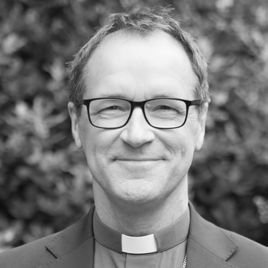
The Anglican Consultative Council (ACC) is a unique body in the Anglican Communion. It is one of the four ‘Instruments of Communion’, those elements of the Communion’s life that hold it together, alongside the Archbishop of Canterbury, the Lambeth Conference and the Primates’ Meeting. It is unique because it is the only one where lay people and priests are involved. All the other others are made up of bishops or archbishops. ACC-18 met in Ghana in February 2023. It met at a particularly sensitive time for the Communion. Just before the meeting, the General Synod of the Church of England had voted to approve the use of ‘Prayers of Love and Faith’, prayers that could be used in regular services for same-sex couples, which included prayers of blessing on them as people, if not technically on their partnerships or marriages. This had been the outcome of a process within the Church of England begun by Archbishop Justin Welby in 2017 to explore issues of human sexuality within the Church and within wider society. Tensions were therefore high on the eve of the meeting. Archbishop Justin’s remarks at the opening of the conference focused on the long-standing principle of the autonomy of Member Churches and yet their interdependence. Member Churches are free to discern the shape of their own witness in their own context and yet we must find ways, as he put it, to “bridge the gap between interdependence and autonomy without the abuse of power.” He went on to argue that the Instruments of Communion themselves must evolve: ‘The Instruments have grown and changed over the years. They have responded to changes caused by wars, colonialism, decolonising, corruption and failure, heresies and schisms, technological and scientific advance. They have never had the character of Synods with either doctrinal or ethical authority over the Communion, but they do have moral force. But history shows us that when times change, so must the Instruments of Communion…. I will not cling to place or position as an Instrument of Communion. The role of the Archbishop of Canterbury, the See of Canterbury, is an historic one. The Instruments must change with the times.’ (1) It was in this context that a piece of work was proposed and commissioned by the ACC which with which I became closely involved. Since 2020 I have served as the Chair of the Inter Anglican Standing Commission on Unity, Faith and Order (IASCUFO), one of the permanent commissions of the Anglican Communion, which reports to the ACC, and responds to requests for advice or theological work which may come from any of the four Instruments. IASCUFO had proposed doing a piece of work to address the issue of how we handle our disagreements within the Communion in as godly and theologically responsible a way as possible. The formal resolution of the ACC was to ask IASCUFO “to explore theological questions regarding structure and decision-making to help address our diff erences in the Anglican Communion”. It “affi rm(ed) the importance of seeking to walk together to the highest degree possible… learning from our ecumenical conversations how to accommodate diff erentiation patiently and respectfully”. Over the following years a subgroup of IASCUFO met in Nairobi, and the full Commission met in Cairo, and so the Nairobi-Cairo Proposals (NCPs) were published in Advent 2024. After a year of listening to responses and feedback from around the Communion, IASCUFO met again in Rome in December 2025 and issued a Supplement, responding to and amending in various ways the proposals themselves. The NCPs will therefore be considered at ACC-19 in Belfast in June 2026.What is the Anglican Communion?As IASCUFO began its work, we returned to the classic, often-quoted description of the Anglican Communion which dates back to Resolution 49 of the Lambeth Conference of 1930, namely that “The Anglican Communion is a fellowship, within the one Holy Catholic and Apostolic Church, of those duly constituted dioceses, provinces or regional Churches in communion with the See of Canterbury”. The context of this statement often goes unnoticed. It is introduced with this phrase: “The Conference approves the following statement of the nature and status of the Anglican Communion” (italics added). The implication was that this was not so much a defi nition, as a description of the current ‘nature and status’ of the Communion. Similarly, the resolution ends by looking forward to “the time when the Churches of the present Anglican Communion will enter into communion with other parts of the Catholic Church not definable as Anglican as a step towards the ultimate reunion of all Christendom in one visibly united fellowship”. In other words, this was a conditional description of the state of the Communion in 1930, rather than a definition for all time. As Andrew Atherstone, Professor of Modern Anglicanism at the University of Oxford, has shown, Resolution 49 of Lambeth 1930 has an “explicit provisionality”, arguing that the phrase “in communion with the see of Canterbury” was promoted by an older generation of Anglo- Catholic ecclesiologists in the nineteenth century, as a way to “defend the historic origins and claims of their own church. This was typical of polemics defending the Church of England’s right to be known as the true representative of Catholic Christianity in England, against the rival claims of Roman Catholicism”.(2) Since 1930, of course, the Anglican Communion has changed dramatically in a number of ways, which may give rise to the need for re-visiting that description. Changing Demographics A glance at a picture of the bishops at the 1930 Lambeth Conference, seated in front of Lambeth Palace, compared to pictures of more recent conferences, reveals some stark differences. The first difference is numbers. In 1930, 308 bishops gathered. In the 2022 Lambeth Conference, there were more than double that number, not to mention the bishops’ spouses who gathered for a parallel and inter-related conference at the time. The second very obvious difference is that almost all the 1930 bishops were white. Looking back at those times from a 21st-century...
