
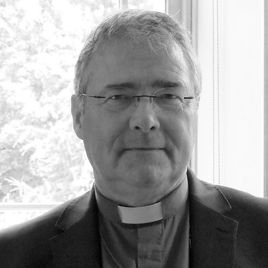
Preface THE FORTHCOMING MEETING of the Anglican Consultative Council (ACC) in Belfast, 27th June – 4th July, provides a focus for this summer edition of Search. The Guest Editor, Dr Bridget Nichols, has asked me to write a piece as someone who has been involved closely in the build up to the Conference and also to the evolution of what will be one of the principal topics of debate at the gathering in Belfast – The Nairobi-Cairo Proposals (NCP).The NCP are the response to a task given by ACC-18 meeting in Accra, Ghana in 2022 to the Inter-Anglican Standing Committee on Unity, Faith and Order (IASCUFO). IASCUFO is composed of members (theologians, bishops, clergy and lay people) from a very wide range of Provinces of the Anglican Communion. The way they have approached this task under the chairmanship of Bishop Graham Tomlin and ably advised by Dr Christopher Wells of the Anglican Communion Office has been exemplary in its comprehensiveness and its thoroughness. That they have undertaken this work at time of turbulence and often unnecessary distraction within the Communion is a testimony to their commitment to the Communion and to the Anglican method. Before moving into the substance of Anglican Communion matters, I think it is worthwhile emphasising that authority within Anglicanism is said to be “diffused” or “dispersed”; it is not “devolved”, i.e., it has not been given by some legitimate institutional authority to others. No person or body has ever owned it except the Lord of the Church, Jesus Christ. To some degree that is why Anglicanism has been the despair of more “line of command” or confessional type Churches. Introduction Over the past year or so I have repeatedly come across a quotation from the Prison Notebooks of the Italian left wing intellectual, Antonio Gramsci. I have seen it quoted in periodicals, magazines, learned journals and even in Church publications. If it wasn’t well known before it should be by now: The crisis consists precisely in the fact that the old is dying and the new cannot be born: in this interregnum a great variety of morbid symptoms appear. Although Gramsci’s words have found a new audience in an age of political dislocation, his observations could be applied (almost) equally to what is being experienced within the Anglican Communion as we work our way through how best to help the structures of the Communion adapt to a post-colonial and multipolar world. There is a clear need for some reform of the Instruments of Communion to resemble more closely the Communion of which they are an expression on unity and that has been the task which the NCP address. True to form as the Anglican Communion, we will go about achieving this reform publicly, slowly and probably messily. But transparency is to be welcomed, patience is a virtue and a certain amount of mess is always part of the creative process. We move slowly and try not to break things. These are evidence of healthy and vigorous life and contrast sharply with the morbidity of self-appointed oligarchies who claim to embody the future but represent only a fraction of the Provinces of the Communion, despite their pretensions to speak for whole. The Nairobi-Cairo Proposals and the Instruments of Communion To quote Bishop Ken Kearon, from his essay “Developing Anglicanism”, published in the Spring 2026 edition of Search, “The Instruments of Communion are important because they provide the organisational structure for dialogue and communion which are intrinsic to this Anglican approach to the fundamentals of Christian faith and the resolution of differences…”.(1) It is for this reason that the current efforts at reforming the structures of the Communion in the form of The Nairobi-Cairo Proposals (NCP) have concentrated on some small adjustments to these Instruments. They have also proposed an updated version of the description of the Anglican Communion as suggested by the Lambeth Conference of 1930. So far, the updated description, which takes into account the development of consultative structures other than the Lambeth Conference, particularly the inclusion of lay representatives on the Anglican Consultative Council (ACC), has not proved controversial. No doubt it will be debated at the forthcoming meeting of the ACC in Belfast in June/July of this year, but I would be surprised if it was not accepted in broadly the form in which it is presented. However, the reforms suggested in relation to the Primates’ Meeting and the re-articulation of the relationship between the Provinces of the Communion and the Archbishop of Canterbury/Church of England have been more variously received. Bishop Graham Tomlin has drawn attention in this issue to the particular difficulties which have been raised in response to specific suggestions in NCP. Perhaps the best approach I can take is to say something in turn about each of the instruments of Communion from the perspective of someone who participates in three of the four. The Lambeth Conference (LC) In his essay for the Spring edition of Search referred to above, Bishop Kearon has this, inter alia, to say about the purpose of the Lambeth Conference: “The Conference itself is clear that it seeks to express the mind of the Communion on a variety of issues during its meetings”.(2) As far as my limited experience goes, the Lambeth Conference has ceased to do this and, as currently constituted and organised, cannot do it. Whatever you may feel about the role of Bishops in relation to both Provincial Synods and the other Instruments of Communion, they have a clear role in interpreting, embodying and defending the Faith and Order of the Province and the Communion. That much is clear from our Ordination vows. Although it may seem like a small thing, this essential role of the Lambeth Conference was (probably unintentionally) undermined during the planning of Lambeth 2022 by giving it the official title, “The Lambeth Conference for Bishops and Spouses”. The husband or wife of a bishop will almost always play a crucial role in encouraging and supporting the ministry of his...
